What Has Martial Arts Done Successful to Stay in Business
The martial arts industry is growing in popularity. This is particularly true in the US, where many areas are experiencing growth. Only when did the industry start making waves in the fettle world, and what does the futurity concord?
It's critical to stay on top of trends and statistics in any fitness industry. New figures emerge and help us predict the future of the manufacture, and adapt strategies accordingly. We've previously discussed the martial arts trends you demand to know, and in this commodity, we'll explore the martial arts business statistics worth knowing – and what they mean for the manufacture. Start, we'll dive into the history of martial arts to pinpoint where and when the involvement began gaining momentum.
An Overview of Martial Arts
Practicing martial arts tin can benefit a person both mentally and physically. A report revealed that those who practise martial arts gain faster reaction times and ameliorate balance over time, and historically, a report from the American Journal of Psychotherapy suggested that martial arts can act as a form of mental therapy.
The practice of martial arts dates back thousands of years. However, more recently, the industry has come a long way and developed hugely. These changes have promoted global awareness of martial arts and in turn, increased popularity.
The Ascension of Mixed Martial Arts
Founded in the US in 1993, The Ultimate Fighting Championship was the beginning of a whole new kind of competitive martial arts. The UFC is the largest Mixed Martial Arts promotion visitor in the world. It has played a massive role in bringing attention to martial arts as a whole.
As its name implies, MMA is a combination of martial arts including Karate, Kempo, Judo, Jiu-Jitsu, Taekwondo, and Muay Thai, among others. MMA will also frequently include techniques derived from kickboxing, battle, and wrestling – depending on the specific discipline.
Mixed martial arts began its motion into the fettle world around ten years ago, by making its manner into wellness clubs and gyms. At the time, Kara Thompson, PR Coordinator for the IHRSA, put this downward to the consumer desire to notice new ways to workout, calculation that "the UFC phenomenon has aided the interest in mixed martial arts." Its popularity since so has soared, with a 2018 study from Statista showing that the number of participants in the Usa anile six years and higher up in mixed martial arts competitions amounted to approximately 977 thousand.
Economic Modify and Its Effect on the Industry
The UFC and MMA brought new recognition to martial arts. Just unfortunately, like many industries, information technology could not escape the economic backlash of the mid-2000'southward recession. Figures show a decline in student participation after the recession striking in 2007, but once the economy began to recover, so did martial arts.
Simmons Market Research reveals statistics in martial arts that represent with the economic climate as it began climbing out of recession in 2010. According to the research, 18.1 meg Americans practiced a form of martial arts at to the lowest degree once between 2010-2011, comprising 9.4 million adults, five.5 one thousand thousand teenagers, and 3.2 million children. At this fourth dimension, information technology was besides noted that 52% of members were men, with 48% women. This gender breakdown has changed since, with an fifty-fifty higher percentage of males participating. We'll explore these statistics a little later in the article.
A 2018 report from Statista shows a correlation betwixt income and participation in martial arts. 7.83% of respondents who stated their income was high said they participated in the action. This is also the example in a report from Simmons Market Inquiry. The study revealed that 28% of children who take part in martial arts training are from households earning a minimum of $fifty,000. In comparison, just x% of those from families earning less than this effigy take role in martial arts.
Martial Arts and the Economy Today
In today'south climate, Frank Silverman, Executive Manager of the Martial Arts Manufacture Clan, sees no reason for turbulent economies to affect the martial arts thriving future. He notes, "I meet every reason to believe schools that are professionally and safely managed, and that teach prophylactic, quality martial arts with peak-notch instructors will thrive for years to come. The truth is, I tin can't imagine a scenario in which a professionally run, condom, the quality-oriented schoolhouse will non thrive in 2019 and for years and years to come up, even in upwards-and-down economies."
Consumer Trends and the Martial Arts Manufacture
Contempo figures show that around 3.6 million people are now practicing martial arts. Inquiry from IBIS World highlights a 4.2% growth from 2012-2017, with predictions for continued growth over the next several years. While these figures predict a steady increase, the many disciplines of martial arts are continuously expanding, attracting more than people, and simply like the boutique fitness manufacture; they are changing with the times to meet consumer needs.
The Feel-Driven Consumer
Similarly to the boutique fitness boom, increased consumer interest in recreational activities has massively influenced the growth of the martial arts industry. As Kevin Logan, U.S main economist for HSBC, notes; there has been a steady drop in consumers purchasing clothing and shoes, and instead, they are spending on eating out, travel, and recreation.
The Pinnacle 10 Barriers
Slowing Your Fitness
Business Growth
Discover more
Proving a shift in what's become relevant to consumers, this tendency combined with the growing popularity of martial arts and the use of social media has meant more than exposure for the practice. A quick Instagram search for the hashtag #martialarts reveals over 7.8 1000000 posts. It's rubber to say that platforms similar Instagram have helped the industry, as the content shared promotes a lifestyle – and invites people to become a office of an feel and a community. Social media marketing has paved the way for schools to promote sensation of the martial arts, as well every bit their school, lessons, and what they have to offering.
Martial Arts Trends
Broader consumer interests and habits are often mirrored throughout many different industries. Nevertheless, Silverman (executive manager, MAIA) warns that interim impulsively on martial arts trends is not to be rushed. He notes that martial arts business owners must sympathise that when a trend develops, information technology's of import non to abandon their existing core martial arts product. Instead, Silverman recommends to "view a trend as an opportunity and decided if we want to take reward of it."
Say, for instance, that yous're a martial arts studio offering personal training sessions focusing specifically on karate. There's no demand to spring on any 'shiny new' martial arts trend as soon as you hear about it. I of the best things yous can exercise when faced with this temptation is to consult your students. Practise they want to see this type of discipline at your school? Would they be interested in trying it, or are they happy with the quality of karate you already offer? At the terminate of the day, keeping your students happy keeps your business organisation running!
Technology
The ascension popularity of vesture engineering science is some other consumer trend that is impacting the industry. Fitness tech has adult at an astonishingly fast rate over the last few years. It is now entering the MMA space. The global wear sensor market is estimated to reach $i.nine 1000000 past 2024.
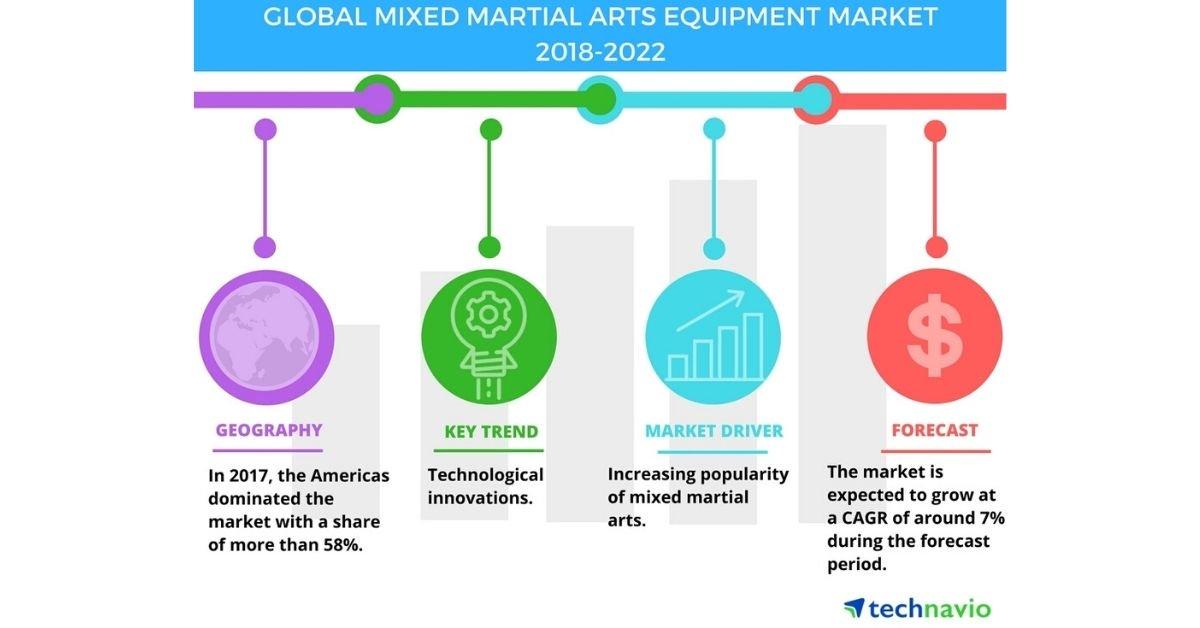
A report from Technavio highlights innovation in this area equally a primal tendency in global growth, especially when it comes to the mixed martial arts equipment market, which is expected to achieve $565 million past 2022.
Source: www.businesswire.com
The UFC Strength Tracker is an example of what the manufacture tech is capable of and where information technology'southward already going. The tracker merges the divide between martial arts and technology. The smart device connects to the punching bags from the XFORCE App and links to your telephone via Bluetooth. Its sensor provides metrics such as force and speed and operates for both boot and punching in real-time.
What's Next For the Martial Arts Industry?
Statistics allow the states to interruption the electric current consumer interest in martial into 4 main categories. Inquiry from IBIS World reveals that 35% of those participating in the industry take MMA classes. This is followed by karate at 22.2%, taekwondo at 12.8%, and judo at 10.2%.
According to the IBIS World written report, the demand for martial arts will rise as economic weather continue to improve. The report records 2019's full revenue at $5billion, with fourscore,559 martial arts businesses in functioning.
The industry serves a diverse audition, but at the moment, instruction is focused primarily on males and the youth market. Males now account for 64.7% of the industry'south members. Those under the age of 17 generate the largest sum of martial arts revenue, accounting for 55.7%.
In that location'southward ascent popularity in mixed martial arts and increased involvement in recreational activities. These factors have leade to increased spending in the martial arts industry.
Martial arts come from a complex historical and social background. But every yr, the marketplace continues to modify and develop. With the increasing popularity, it'sits a great time to be in the martial arts business.
guillotposinion66.blogspot.com
Source: https://www.glofox.com/blog/martial-arts-business-statistics/
0 Response to "What Has Martial Arts Done Successful to Stay in Business"
Post a Comment