Obamas Jobs Agains Last Year in Office

President Obama speaks to Caterpillar employees in East Peoria, Sick., in February 2009 virtually the then-struggling economy. Charles Dharapak/AP hibernate caption
toggle caption
Charles Dharapak/AP
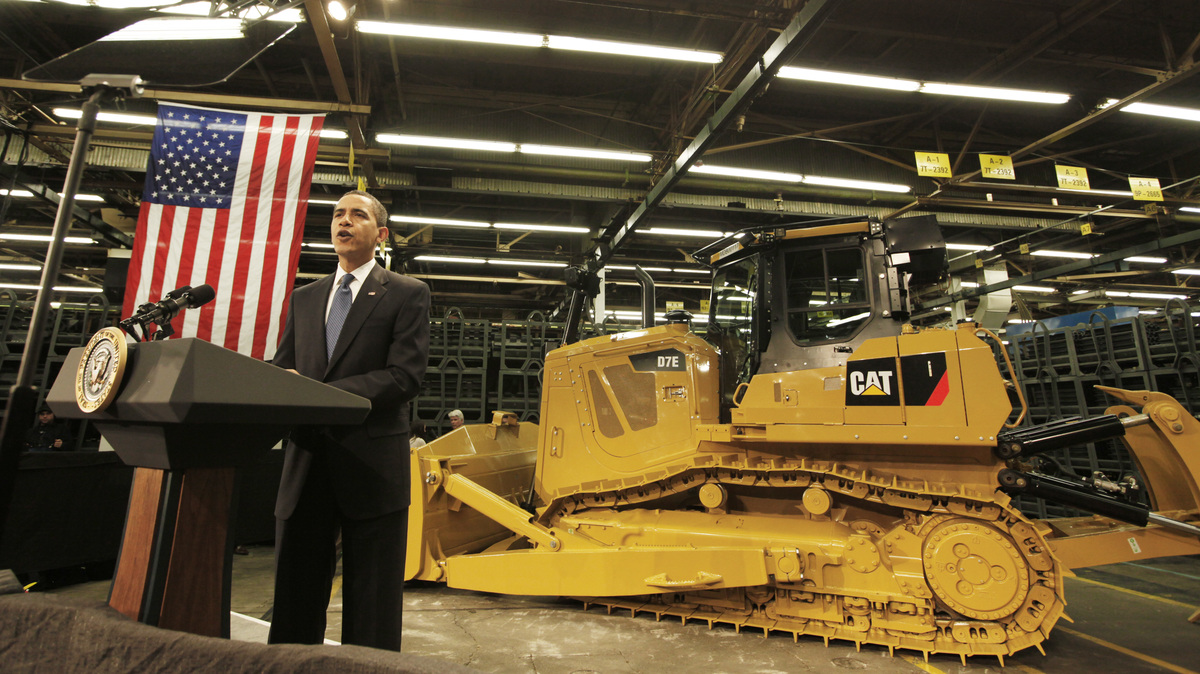
President Obama speaks to Caterpillar employees in Due east Peoria, Ill., in Feb 2009 about the and so-struggling economy.
Charles Dharapak/AP
The terminal affiliate of the Obama economy drew that much closer to its end on Friday, with the terminal jobs report of the 44th president'south fourth dimension in function. That report showed the 75th straight month of job growth, with employers calculation 156,000 jobs.
Solid, but zippo flashy.
In that manner, it was emblematic of how the task market has generally fared since the worst of the Great Recession's aftermath: chugging forth, slowly only surely recovering.
With the final Obama administration jobs day in the books, it'south a good fourth dimension to await at how American workers have fared. Donald Trump will inherit a chore market that is vastly rehabilitated from devastating lows just a few years ago. However, information technology has besides undergone profound changes that accept scarred many American workers.
Unemployment: How low can information technology go?
Equally Obama prepares to leave function, the unemployment rate is at 4.7 pct, less than half of the acme information technology reached in Oct 2009.
That turn down is the upshot of a prolonged menses of job growth. The assistants has grown addicted of showing off its prolonged run of job growth every month.
For some perspective, hither's how big that job growth was: Obama averaged 109,000 jobs per month. That's far better than either President Bush experienced, just it'southward well below the 242,000 that Bill Clinton presided over in the roaring 1990s. For Reagan, it was 166,000.
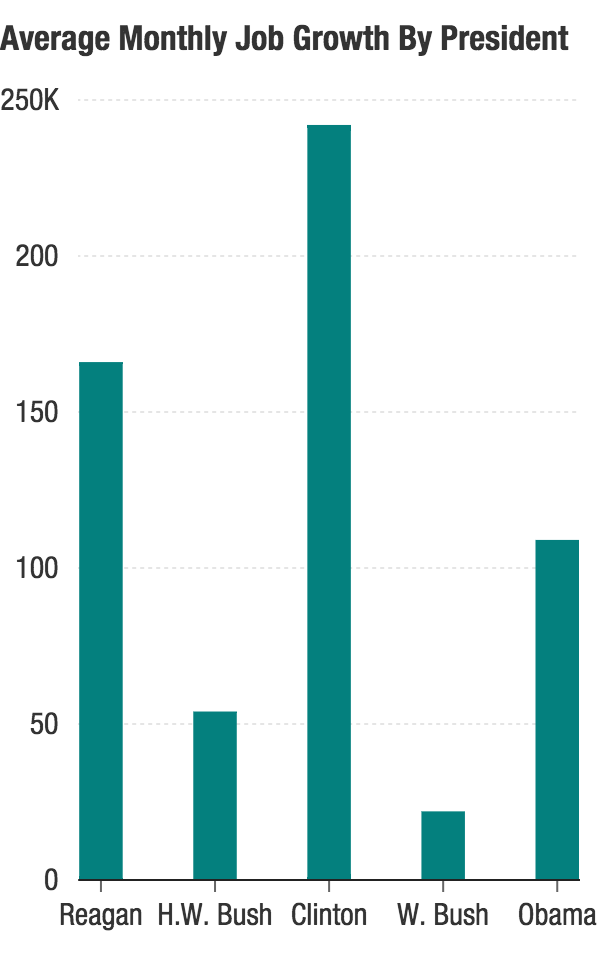
Federal Reserve Banking company of St. Louis
Of course, President Obama came into office as the economic system was plunging into a recession (a plunge that besides drags downwardly George W. Bush's number). Merely even if you boilerplate out Obama'south 75 straight months of job growth, you get 199,000 jobs per calendar month, nonetheless shy of Clinton'south economic system.
In other words, the Obama recovery has been moderate, only remarkably steady. The question is how long that steady climb tin can continue uninterrupted. The unemployment rate is already near a 9-year low, as Steven Russolillo at the Wall Street Journal pointed out this week, and there is some question among economists how depression it can go.
Wages finally climbing
Having a job is one thing. Having a task that pays well is another. And slowly through Obama'due south tenure, those wages take inched upward. In fact, wages were one bright spot of Friday'southward jobs study. Boilerplate hourly wages were up past ii.9 percentage in December. After several years of hovering around two percent, that'due south welcome growth.
Aside from meaning more money in workers' pockets, wage growth serves as however another sign of a tightening labor market, signaling that employers are willing to pay more to attract workers.
Rising wages may inspire the Federal Reserve to take its human foot further off the gas pedal in the coming months (that is, allow interest rates to rise) — a reminder that the economy isn't exactly under the president's control. (More on this later.)
Labor force participation is depression, but what does information technology mean?
This one became a flashpoint in the presidential ballot, with Trump at times pointing out how much the labor strength shrank under Obama. The main measure out of this is the labor force participation rate — that is, the percentage of people who are either working or looking for work (that is, who are in the labor forcefulness).
That effigy was at 65.vii percent in Jan 2009, at the start of Obama's presidency, and today is at 62.7 percent — a steep drib. And today, the effigy is well below its 2000 high of 67.3 pct.
Only it'southward non clear how bad or how benign that alter is. Many Americans are out of the labor force and entirely happy about information technology. Quitting work to retire, for example, is a totally nonalarming reason to leave the labor forcefulness. But then, at that place may be many people who, facing a tough job market, have given up looking for work. That'due south not skillful, and it as well happened for many Americans both during and after the recession.
In the aftermath of the recession, economists have tried to figure out exactly how many people are voluntarily versus involuntarily out of the labor strength. As of 2014, the nonpartisan Congressional Budget Role estimated that half the decline in the participation rate at that fourth dimension had come from "long-term trends" like crumbling — every bit baby boomers historic period, that means a large chunk of the population will naturally retire. But that left half of the decline a result of economical weakness and a slow recovery, in the CBO'south interpretation.
Should the participation charge per unit hold steady or pitter-patter upward during a Trump presidency, that could keep the unemployment charge per unit from dropping, equally only Americans who are looking for piece of work are counted as "unemployed." That would be one of those cases where a slightly higher unemployment rate could be a good thing.
Comeback for part-time workers
Total-time task growth over the course of the Obama presidency has far outstripped role-time job growth, as FiveThirtyEight's Ben Casselman has pointed out.
Of course, some of those people working role time desire to exist working role fourth dimension, and some don't. Another bright spot hither is that the share of those workers who are involuntarily office time has fallen off.
However, that effigy is withal a fair bit higher than it was prior to the recession (and that level was itself, in turn, college than information technology was before the prior recession). That'southward ane place where there could still be some improvement — in that location are nonetheless most one 1000000 more of those involuntary part-time workers than at that place were prior to the recession.
An economic system more about doing than making
Politicians of both parties love to talk nigh manufacturing. Obama pushed manufacturing initiatives throughout his presidency, and Trump built much of his economic message during the entrada around singing the praises of America's manufacturers.
But when information technology comes to employment, the appurtenances-producing share of the economic system has connected to fall. Throughout the by few decades, the share of Americans who brand things — people in manufacturing, mining, logging and construction — has fallen off, and that trend continued during the contempo recession, finally flattening out toward the end.
Nosotros present this chart over a longer time frame, which makes it a piddling bit of a cheat — this isn't exactly a measure of Obama's "record on jobs." Nor is information technology necessarily a measure of economical weakness; in fact, manufacturing has, cheers to technological advances, maintained strong output while shedding workers.
Information technology's a reminder that all the usual macroeconomic indicators (unemployment, wages, labor force participation, GDP) tin can quantify a lot of things in the economic system, merely you have to dig in to learn about the quality of that economy — what exactly is going on behind those numbers. This refuse in appurtenances-producing jobs doesn't signal that the economy is getting worse or improve — it's just irresolute, in this case to go more focused on providing services, instead of goods.
All of this is to say that Trump inherits a job market that is humming along comfortably, given how poor of shape it was in only recently. But it's also an economy that has sharply moved away from manufacturing and other appurtenances-producing industries — the very ones he pushed the most in the election. That change has injure plenty of Americans, despite the job market's improvement.
Trump has tried to merits credit for several hundred goods-producing jobs here and in that location (credit that he doesn't always deserve, every bit the Washington Mail service's Philip Bump has reported), just bringing manufacturing employment dorsum in a sizable manner seems like a tall order for whatsoever president. Furthermore, culling piece of work — like driving an Uber or Lyft — continues to abound quickly as a share of the economy. That change could eventually require policy attention, every bit more workers take jobs that don't come with benefits.
But there's some other big caveat here. Presidents get lots of credit and blame for the economy'south functioning, despite the fact that they don't really have firm command over that performance. (If they did, why would recessions ever happen?)
Aye, a president can push an economical agenda and in some cases push button particular policies that end upwardly having a sizable bear upon on the economy (come across: the 2009 stimulus parcel, which undeniably had a positive impact).
Only they besides demand Congress to enact those policies. Not only that, merely the Federal Reserve has its own ready of controls — a gear up to which the president does not take admission, despite some conspiracies of politically motivated Fed scale-tipping.
And then, similar Obama, whatsoever happens to the economic system under Trump, he may not deserve whatever credit he may merits (and the same goes for whatever blame is thrown his style).
guillotposinion66.blogspot.com
Source: https://www.npr.org/2017/01/07/508600239/what-kind-of-jobs-president-has-obama-been-in-8-charts
0 Response to "Obamas Jobs Agains Last Year in Office"
Post a Comment