What if Everyone Voted to Make Slavery Again
Subsequently returning home from World War Two, veteran Medgar Evers decided to vote in a Mississippi election. But when he and some other black ex-servicemen attempted to vote, a white mob stopped them. "All we wanted to be was ordinary citizens," Evers afterwards related. "We fought during the war for America, Mississippi included. Now, after the Germans and Japanese hadn't killed usa, it looked every bit though the white Mississippians would...."
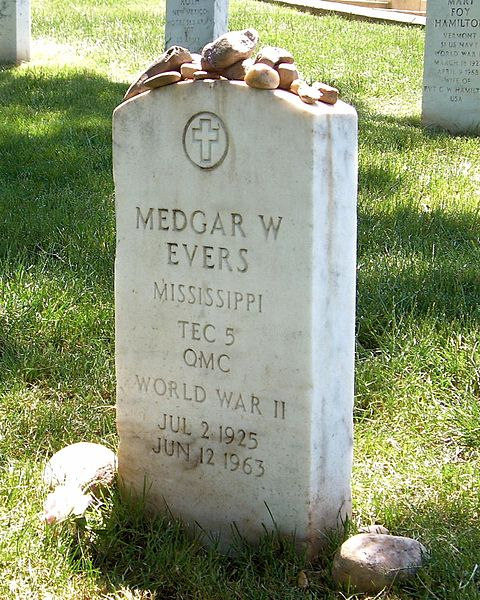 |
| Grave of civil rights activist Medgar Evers in Arlington National Cemetery. (Wikimedia Commons) |
The most basic correct of a citizen in a republic is the right to vote. Without this correct, people can be easily ignored and even driveling by their regime. This, in fact, is what happened to African-American citizens living in the South post-obit Ceremonious War Reconstruction. Despite the 14th and 15th Amendments guaranteeing the civil rights of black Americans, their correct to vote was systematically taken abroad by white supremacist state governments.
Voting During Reconstruction
Subsequently the Civil State of war, Congress acted to prevent Southerners from re-establishing white supremacy. In 1867, the Radical Republicans in Congress imposed federal armed forces rule over well-nigh of the South. Under U.S. Regular army occupation, the former Confederate states wrote new constitutions and were readmitted to the Spousal relationship, but only after ratifying the 14th Amendment. This Reconstruction amendment prohibited states from denying "the equal protection of the laws" to U.Southward. citizens, which included the former slaves.
In 1870, the 15th Amendment was ratified. Information technology stated that, "The correct of citizens of the United States to vote shall not exist denied or abridged by the United States or by whatsoever Country on account of race, colour, or previous condition of servitude."
More than than a half-million black men became voters in the Due south during the 1870s (women did not secure the right to vote in the United states of america until 1920). For the most part, these new black voters cast their ballots solidly for the Republican Party, the party of the Peachy Emancipator, Abraham Lincoln.
When Mississippi rejoined the Union in 1870, former slaves fabricated up more than than half of that country'due south population. During the adjacent decade, Mississippi sent 2 black U.S. senators to Washington and elected a number of black state officials, including a lieutenant governor. But even though the new black citizens voted freely and in large numbers, whites were still elected to a big majority of state and local offices. This was the design in well-nigh of the Southern states during Reconstruction.
The Republican-controlled state governments in the South were hardly perfect. Many citizens complained about overtaxation and outright corruption. Simply these governments brought about significant improvements in the lives of the erstwhile slaves. For the start time, blackness men and women enjoyed freedom of oral communication and movement, the right of a fair trial, didactics for their children, and all the other privileges and protections of American citizenship. But all this changed when Reconstruction concluded in 1877 and federal troops withdrew from the sometime Confederacy.
Voting in Mississippi
With federal troops no longer present to protect the rights of black citizens, white supremacy rapidly returned to the one-time Amalgamated states. Black voting fell off sharply in most areas because of threats by white employers and violence from the Ku Klux Klan, a ruthless surreptitious organization bent on preserving white supremacy at all costs.
White majorities began to vote out the Republicans and supervene upon them with Democratic governors, legislators, and local officials. Laws were soon passed banning interracial marriages and racially segregating railroad cars along with the public schools.
Laws and practices were also put in place to make sure blacks would never again freely participate in elections. Merely one problem stood in the way of denying African Americans the right to vote: the 15th Amendment, which guaranteed them this correct. To a great extent, Mississippi led the way in overcoming the barrier presented by the 15th Subpoena.
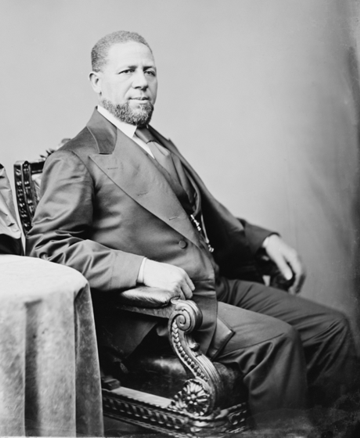 |
| Hiram Rhodes Revels was the first African American to serve in the U.South. House of Representative and later the Senate. Revels served in Congress from 1870 to 1871, representing Mississippi. (Wikimedia Eatables) |
In 1890, Mississippi held a convention to write a new state constitution to replace the one in force since Reconstruction. The white leaders of the convention were clear about their intentions. "Nosotros came here to exclude the Negro," declared the convention president. Because of the 15th Amendment, they could not ban blacks from voting. Instead, they wrote into the state constitution a number of voter restrictions making information technology hard for well-nigh blacks to register to vote.
First, the new constitution required an annual poll tax, which voters had to pay for two years earlier the election. This was a difficult economic brunt to identify on blackness Mississippians, who made up the poorest part of the state's population. Many simply couldn't pay it.
But the most formidable voting barrier put into the state constitution was the literacy test. It required a person seeking to register to vote to read a department of the state constitution and explicate it to the county clerk who processed voter registrations. This clerk, who was always white, decided whether a citizen was literate or not.
The literacy test did not just exclude the threescore percent of voting-age black men (virtually of them ex-slaves) who could not read. It excluded well-nigh all blackness men, because the clerk would select complicated technical passages for them to translate. By contrast, the clerk would pass whites by picking simple sentences in the state constitution for them to explain.
Mississippi also enacted a "grandfather clause" that permitted registering anyone whose grandfather was qualified to vote before the Civil War. Obviously, this benefited only white citizens. The "grandfather clause" equally well as the other legal barriers to black voter registration worked. Mississippi cut the per centum of black voting-historic period men registered to vote from more than 90 percent during Reconstruction to less than 6 per centum in 1892. These measures were copied by most of the other states in the Southward.
The Winds of Change
As a result of intimidation, violence, and racial bigotry in state voting laws, a mere 3 percentage of voting-age black men and women in the Due south were registered to vote in 1940. In Mississippi, less than i percent were registered. Most blacks who did vote lived in the larger cities of the South.
By not having the ability of the election, African Americans in the Due south had petty influence in their communities. They did not concur elected offices. They had no say in how much their taxes would be or what laws would exist passed. They had piffling, if any, control over local police, courts, or public schools. They, in issue, were denied their rights as citizens.
Attempts to change this situation were met with antagonism and outright violence. But in the 1950s, the civil rights movement adult. Facing enormous hostility, black people in the Due south organized to demand their rights guaranteed in the U.S. Constitution. They launched voter registration drives in many Southern communities. This fix the phase for slap-up changes in the 1960s, simply non without tragedy. Medgar Evers, the black veteran stopped past a white mob from voting, became a civil rights leader in his native Mississippi. Because of his ceremonious rights activities, he was shot and killed in front of his dwelling house by a white segregationist in 1963.
For Discussion and Writing
- What legal devices did Southern states utilise to exclude about of their black citizens from voting? What other methods were used to stop blacks from voting?
- What was unfair about the way literacy tests were used for voter registration in the South from 1890 to 1965?
- What were the consequences to African Americans of being excluded from voting in the segregated South?
For Farther Reading
McMillen, Neil R. Dark Journey: Black Mississippians in the Age of Jim Crow. Urbana, Ill.: University of Illinois Printing, 1990.
Bond, Julian & Juan Williams. Optics on the Prize: America's Civil Rights Years, 1954–1965. New York: Penguin Books, 1988.
A C T I V I T Y
Who Should Non Vote?
All states have some voting restrictions. Are they necessary? Beneath are five traditional restrictions on the right to vote. Form small groups to make up one's mind whether your country should retain each of these restrictions. Earlier making a decision on each brake, the group should talk over and write answers to these two questions:
- What are some reasons favoring the restriction?
- What are some reasons against the restriction?
Afterward the groups have finished their work, each restriction should be discussed and voted on past the entire class.
Restrictions on the Right to Vote
In order to vote, you must...
A. Reside in a voting district for at least ane month.
B. Exist at least 18 years of age.
C. Not exist in prison or on parole for a felony confidence.
D. Be a U.S. citizen.
Eastward. Register to vote.
Return to Black History Month Abode Folio
guillotposinion66.blogspot.com
Source: https://www.crf-usa.org/black-history-month/race-and-voting-in-the-segregated-south
0 Response to "What if Everyone Voted to Make Slavery Again"
Post a Comment